

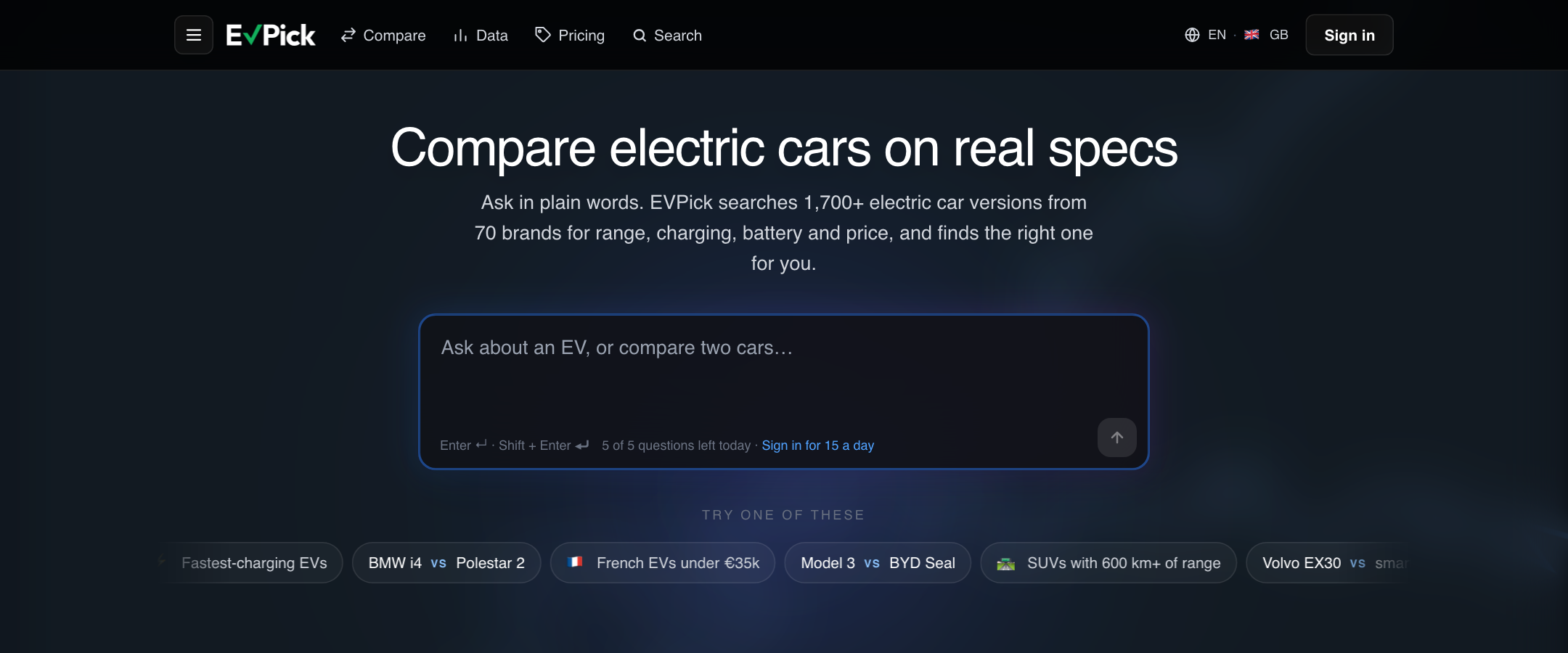
EVPick is a free assistant for choosing an electric car, built with Claude Code. You ask in plain words, “a seven-seater under £50k that charges fast”, and it answers from a catalogue of real specs and prices instead of from whatever a language model half-remembers.
What it actually is
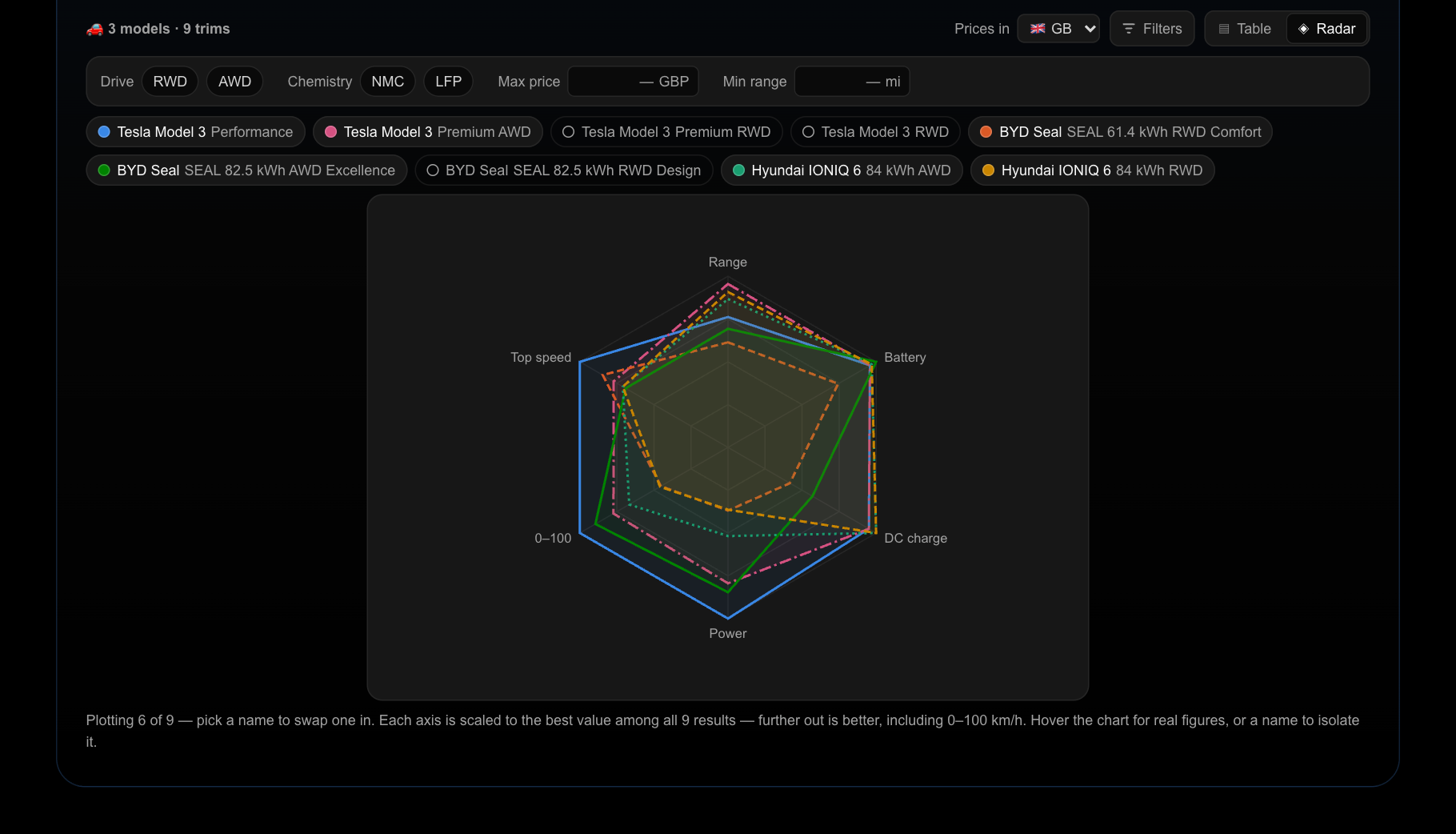
- The assistant. Ask a question, get a short verdict with a sortable table, a radar chart and the price history. Specs and prices it can match to the catalogue are underlined, so you can tell a fact from a comment.
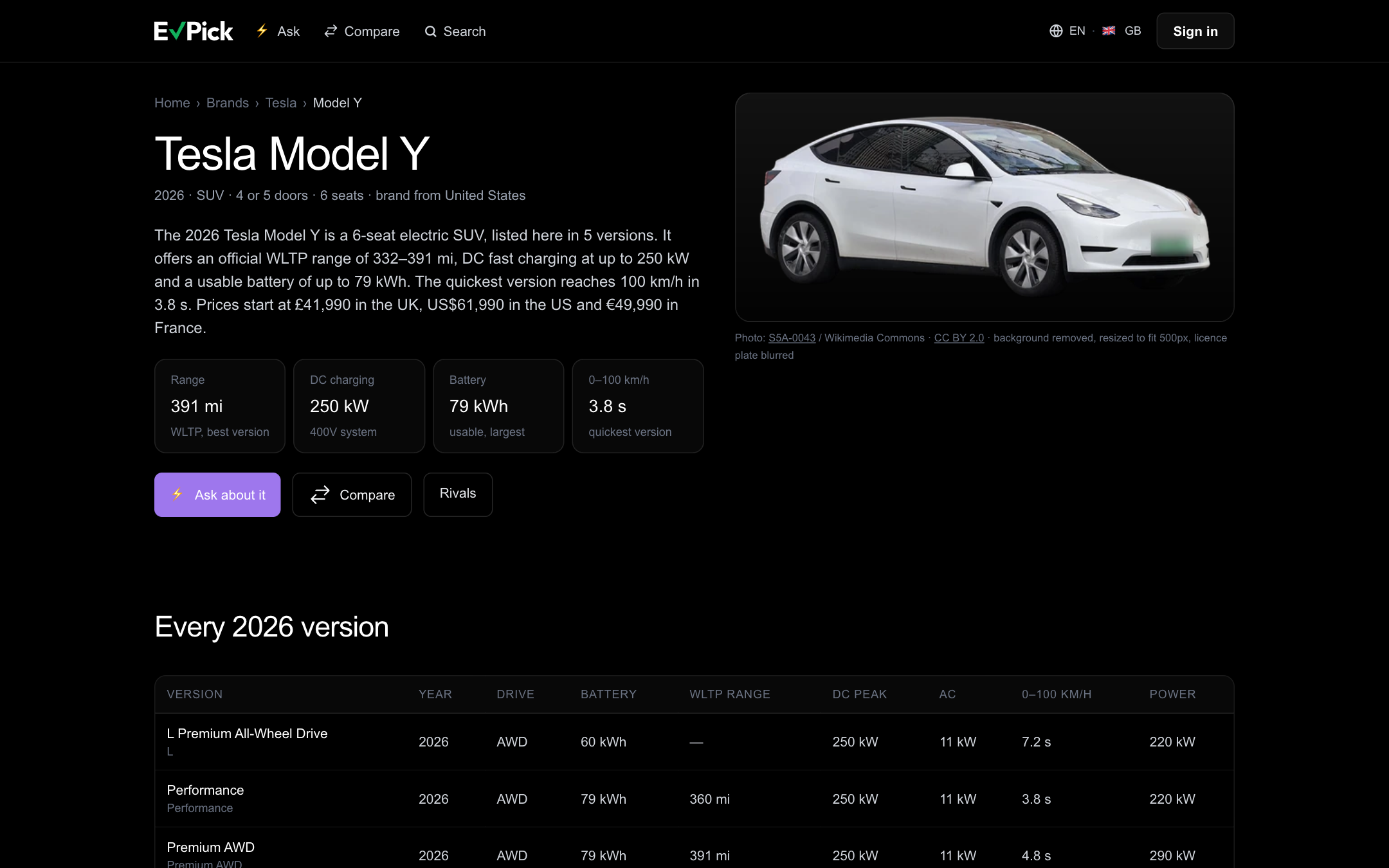
- The catalogue. As I write this: 1,777 versions of 322 models from 70 brands, a page for each, list prices in 11 countries, and a photo for almost every model.
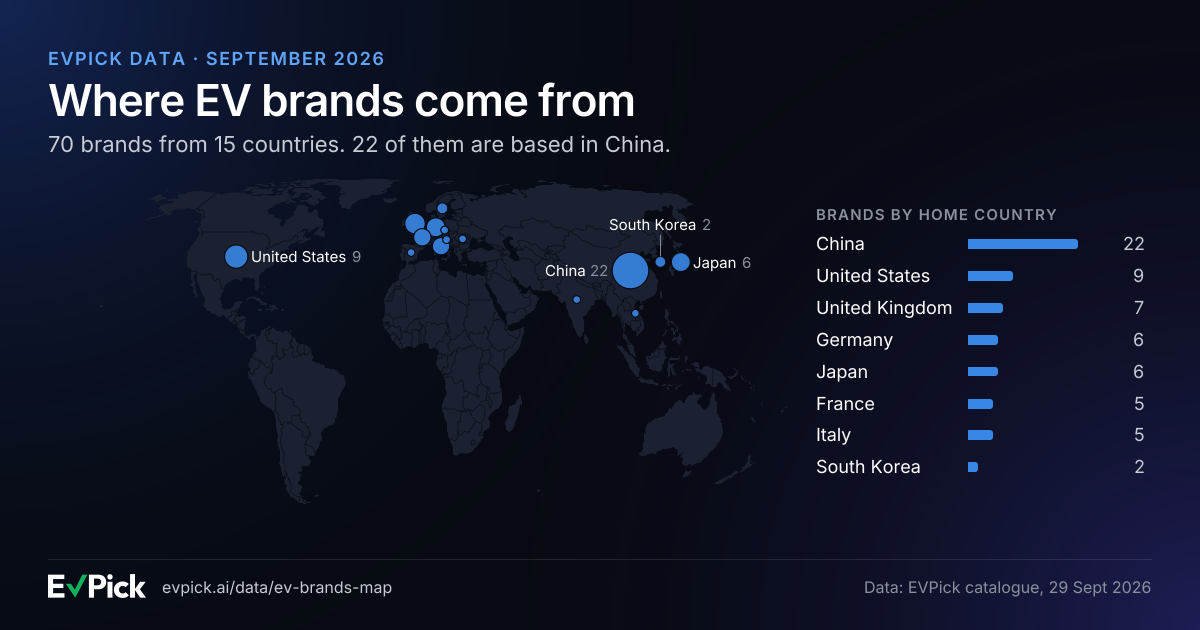
- Around it. 32 rankings, 240 head-to-head comparisons, maps of where EV brands come from and which plug fits where, and a daily quiz that is the same for everyone. All in nine languages.
It is free: five questions a day without an account, fifteen with one, and unlimited browsing. The one paid thing is a 60-day Buyer’s Pass, paid once. You research a car for a few weeks, then you buy it and stop, so a subscription made no sense. And no brand can pay to change an answer or a ranking.
The catalogue is the product
- Static pages. About 6,200 pages in nine languages, rebuilt whenever the catalogue changes, so every car, ranking and comparison loads fast and reads well to search engines.
- Edge cases. Plug-in hybrids arrive looking like terrible EVs (66 km of range, which is only the electric part), and no rule separates them: a Fiat Topolino is a real 5.4 kWh electric car, a Ferrari 296 GTB a 6.5 kWh plug-in hybrid. So they are an explicit list, shown but never ranked.
- Photos. One per model, background cut out, number plate blurred. The one manual step is mine: I approve the actual file that will ship, not a thumbnail.
Prices are the hard part
Specs barely move. Prices never stop. The same car goes by different trim names from one country to the next, reaches a new model year in one market before another, and is sold outright in one place and only on lease in the next. There are eleven markets and seven currencies, and a price is never converted from one to another: each market shows what that market actually charges, or nothing at all.
Matching all of that to the right car is slow, careful work, and it is where a big share of the agent time on this project went. Prices are updated every week, and every car page shows how they moved over time.
The stack
- Next.js 16 with React 19 and Tailwind 4.
- Supabase and Postgres for the chat, the quiz and billing.
- The same HTML for everyone. Static pages carry every market’s prices, and CSS keyed on your country hides the others, so pages can be cached.
- Charts computed at build time. Maps are projected on the server with d3-geo, so the browser never loads d3, and share images come from the same snapshot as the page they preview.
The build stats and the bill
EVPick took longer than Thumb & Pylon or Token Clicker: two and a half months, most of it in September.
| Metric | Value |
|---|---|
| Commits | 389 |
| Working sessions | 53 |
| Tool calls, agents included | ~41,700 |
| Output tokens | 16.1M |
| Cache-read tokens | 6.29B |
| Grand total tokens | 6.47B |
Metered at API-equivalent prices with ccusage, across every session on the project, workflow agents included:
| Model | Cost | Share |
|---|---|---|
| Claude Opus 5 | ~$1,826 | 49.7% |
| Claude Opus 5.5 | ~$1,345 | 36.6% |
| Fable 5.1 | ~$435 | 11.8% |
| Sonnet 5 | ~$71 | 1.9% |
| Total | ~$3,676 | 100% |
As with Thumb & Pylon, this is the pay-as-you-go price of the tokens, and a subscription costs far less out of pocket. One difference: here the tokens and the dollars come from the same tool, so both tables describe the same sessions.
What I take from it
The hard part of EVPick was never the chat. It is keeping a catalogue right, market by market, week after week. The underlines come from the same idea: you should be able to see which parts of an answer come from the catalogue. It is the point I made about vibe coding: let the machine do the work, and make checking it cheap.
If you are shopping for an electric car, or you just like arguing about charging curves, try EVPick. It is a TrendingDevs product. Here it is in twenty seconds, recorded on 22 September, when it covered 68 brands and ten countries:
Car photos in the video are credited on each car's page at evpick.ai.