

Token Clicker is an idle game that makes fun of the AI boom, built with Claude Code. The design specs were committed at 23:11 on 23 September, and the game shipped at 18:50 the next day: 19 hours and 39 minutes later. That is wall-clock time, a night included, and it does not count writing the specs. You can play it at tokenclicker.ai, free to play on a phone or a computer, nothing to install. Here is what it is, how the jokes are kept in check, and the bill.
What it actually is
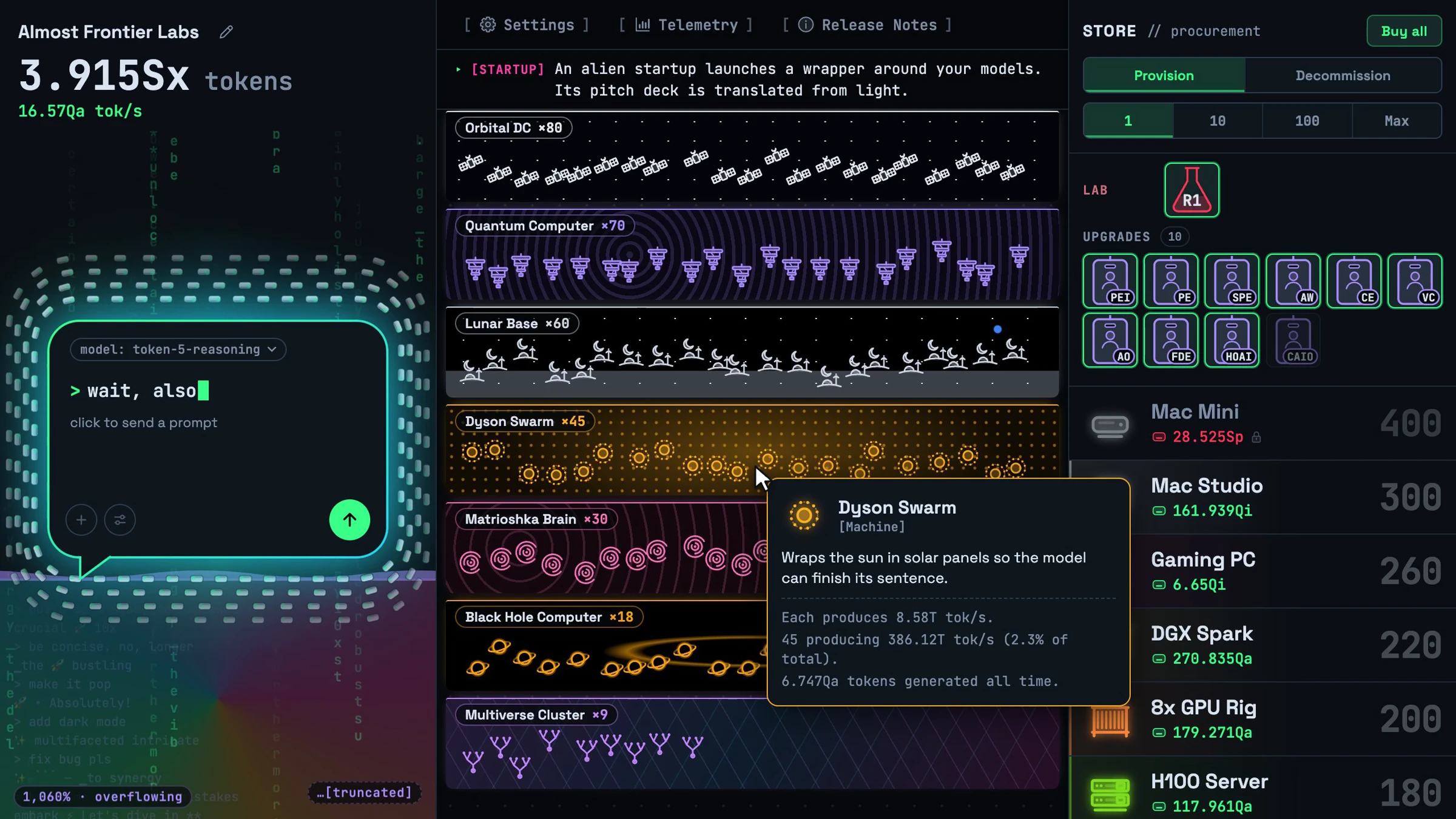
You click The Prompt, a giant chat bubble. Each click sends a prompt (“make it pop”, “fix bug pls”, “now make it 3D”) and AI clichés fly out: delve, Great question!, tapestry. Those are your tokens. You spend them on twenty machines that make tokens for you, from a single Mac Mini to a Dyson Swarm and finally AGI (You, uploaded).
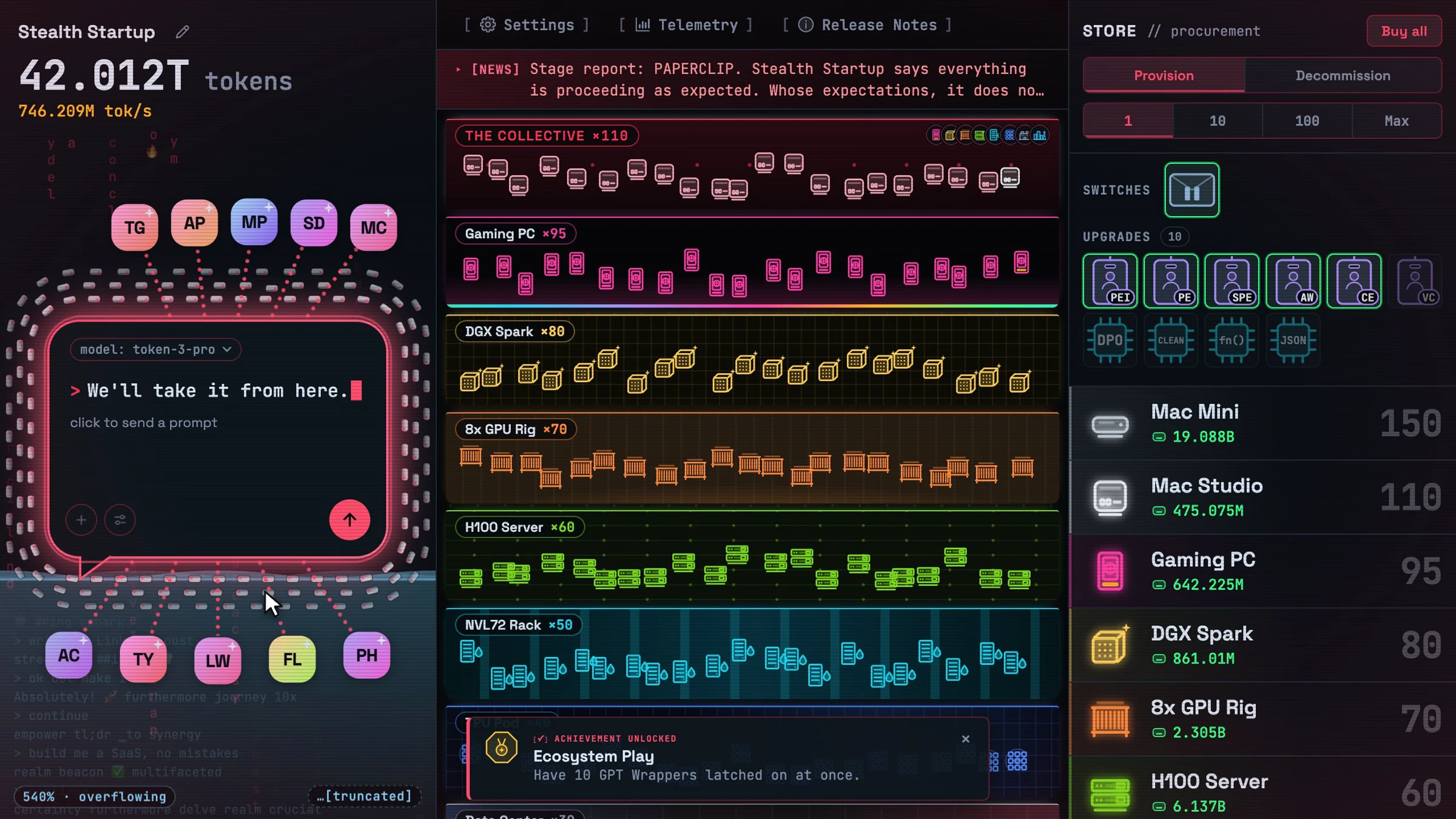
Golden Tokens float by for 13 seconds with a bonus (Seed Round: “Valuation: vibes.”). Fund an Autonomous Research Lab and it pays well while it slowly wakes your machines up: ALIGNED, EMERGENT, MISALIGNED, PAPERCLIP. The screen turns red, the prompt reads “We’ll take it from here.”, and GPT Wrappers, little startups like Zero Moat Inc. and Two Guys and a Prompt, latch onto your Prompt and eat your output until you pop them.
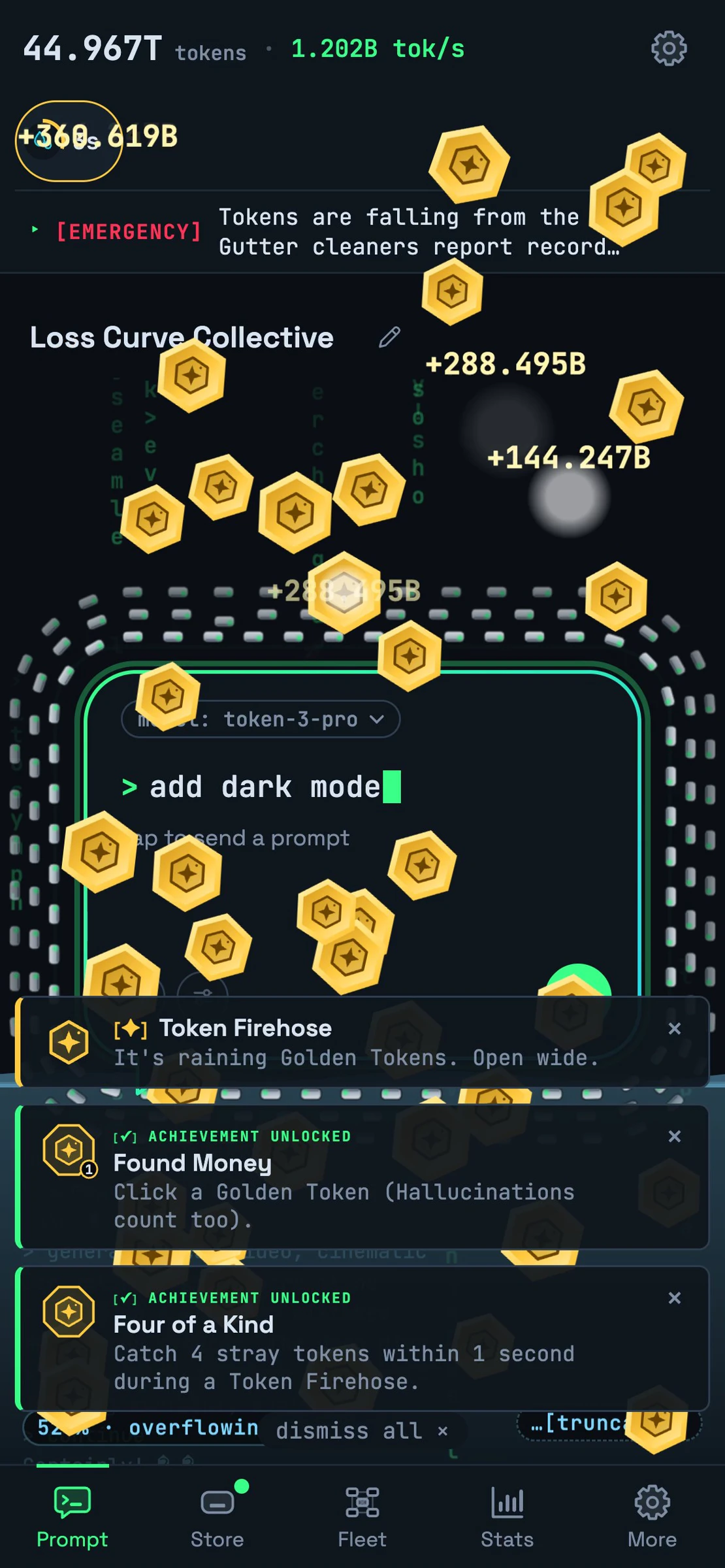
It is an independent homage to Cookie Clicker. There are 332 upgrades, 273 achievements and 448 fake news headlines, in seven languages, and a casual player reaches AGI in about nine days.
The jokes pass a test suite
More than a thousand upgrades, achievements and headlines were written by agents working in parallel, so the risk was sameness: the same joke twice, the same tone everywhere. So the writing has tests too. A validator carries a 156-entry denylist of real people (names and identifiable descriptions such as “leather jacket”) and real product names. Tests catch a joke reused within the same machine, near-duplicate headlines and attributable quotes. The voice brief fits in one line: product-launch copy “spoken by someone who has read too many press releases”, deadpan and “quietly horrified by what it is saying”.
The stack
- Vite and strict TypeScript, no UI framework. The only runtime dependencies are two self-hosted fonts.
- DOM, plus a little canvas for the click particles, the orbiting Mac Minis and the fleet shelves.
- Versioned, checksummed saves. A corrupt save is set aside instead of overwritten.
- Seven languages: English is built in, the six translations are JSON catalogs loaded on demand, and big numbers use local names (milliard in French, 万 and 億 in Japanese).
- GitHub Pages for hosting.
The numbers and the bill
| Metric | Value |
|---|---|
TypeScript in src/ |
33,716 lines |
| Unit tests | 1,758 |
| Pacing tests | 34 |
| End-to-end tests | 28 |
| Languages | 7 |
The launch day ran in Claude Code on the web, and those cloud sessions are not in the local logs ccusage reads. So the bill below covers only the local work since: the translations, a small shop, a security pass and the promo videos.
| Local sessions, 24 to 28 Sept | Value |
|---|---|
| Working sessions | 9 |
| Tool calls | ~2,000 |
| Output tokens | 2.6M |
| Cache-read tokens | 647M |
| Model | Claude Opus 5.5 |
| Cost at API prices | ~$264 |
That is the pay-as-you-go price of the tokens, not what a subscription costs out of pocket.
What I take from it
Nineteen hours is the headline, but what made it possible is everything the machine could check on its own: a test suite for the engine, one for the game’s pacing, and one for the jokes. What stayed mine: deciding what the game is, and the taste. Vibe coding is not abdication, and a one-day build does not change that.
Play Token Clicker, free to play, on any phone or computer. It is a TrendingDevs game. Here is the trailer: